The British soldier of the 1980's, like his predecessor
had to carry everything he needed to survive on the battle field.
Even
in a modern highly mechanised army there were times when the soldier
had to carry heavy loads of personal equipment in to battle.
In
the 1980's the British army under took its most comprehensive re-equipment
program ever; from boots to tanks, nearly every piece of infantry equipment was
replaced or upgraded. Due to the nature of supply and issue which could never
keep up with demand the old and new was in use together well into the early
1990's.
During the Falklands conflict the terrain made it difficult for
vehicles to operate without becoming mired. So the poor old foot
soldier had to result to carrying everything he needed to fight and
survive on his back. Pictures of soldiers marching with over-loaded
bergans, some in excess of 105lbs, have become infamously associated
with the Falklands conflict. Though even this is a myth. Soldiers did
Yomp or march to victory across the Falklands, but they did not carry
these heavy loads every step of the way. Company HQ vehicles, tractors
and occasionally helicopters took some of the strain, carrying the
units bergans forwards where possible. What he did carry every step of
the way was the essentials he needed to survive in the field.
Every soldier is issued with his own set of web
equipment which consists of a belt, yolk, ammunition pouches, kidney
pouches and a large pack. This enables him to carry everything he
needs to survive in the field for 24 hours. In addition to this was
also given NBC kit, poncho, sleeping bag, entrenching tools and a
steel helmet. He also was expected to carry spare clothing, rations,
ammunition and any other piece of equipment he required to carry out
his duties.
Pattern 37 WE
The Pattern 1937 Web Equipment or
'37 Pattern webbing as it was known as, and was developed during the
1930's to replace the 1908 webbing that was used during the first
world war. It consisted of a belt, cross straps, two ammunition
pouches, bayonet frog, water bottle carrier, entrenching tool carrier
and a small pack.
It was used until the introduction
of the '58 Pattern web equipment during the early 1960's. Some
units still used the '37 pattern webbing for training even in 1982 and
it was on issue to army cadet units well into the late 1980's.
Pattern 44 WE
The 1944 pattern Webbing or '44
pattern webbing was introduced to overcome the shortcomings of the '37
pattern webbing. It consisted of a belt, yoke, left and right
ammunition pouches, water bottle carrier and a large pack.
In early 1945, quantities of the
new webbing started being issued to troops in the far east where it
was found to be more suitable and resistant to the tropical climates
encountered than the '37 pattern webbing which rotted quite easily in
the jungles.
It was still used by troops in
tropical areas well into the late 1980's. The metal '44 pattern water bottle
and mug, along with the water bottle carrier was a sought after item,
especially among those serving with the special forces and the
parachute regiment.
Pattern 58 WE
Developed in the late 1950's as a replacement for the '37 and '44 pattern
webbing, the 1958 pattern webbing system was issued from the 1960's onwards and
resembled the '44 pattern webbing. Universally
known as '58 pattern webbing it consisted of a belt,
yoke, left and right ammunition pouches, a set of kidney pouches,
water bottle carrier, cape carrier and large pack. Also developed to
go with the new webbing was a new
poncho, entrenching tools, sleeping bag, and a plastic water bottle
and mug were all designed to fit the '58 pattern webbing. Latter
a new respirator haversack for the s6 respirator was also developed to fit in
with the webbing.
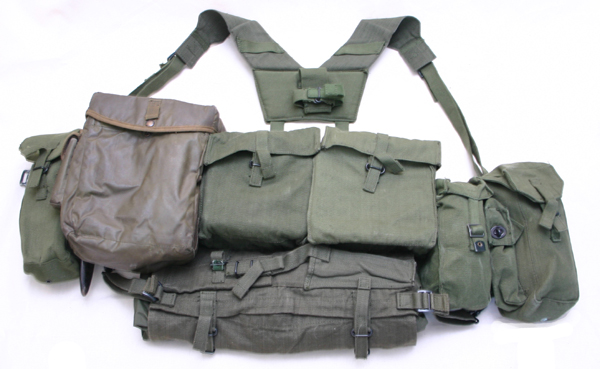
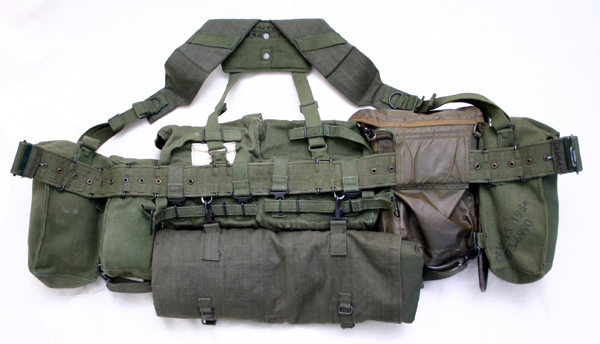
The webbing was of a modular design
allowing it to be configured to suit the users needs and operational
requirements. With he most common adaptation being the position of the
cape carrier which was moved to above the kidney pouches. It was found
that the '44 pattern water bottle carriers were compatible with the
new webbing and it was not uncommon amongst members of elite units to
dispense with the standard kidney pouches and use additional water
bottle pouches along side the '44 pattern water bottle carriers.
It could be argued that the
'58 pattern web equipment can be described as the last of the war time
derived webbing as it owes much of its design to its war time predecessors
and served with rear echelon and Territorial army units well into the
late 1990's.
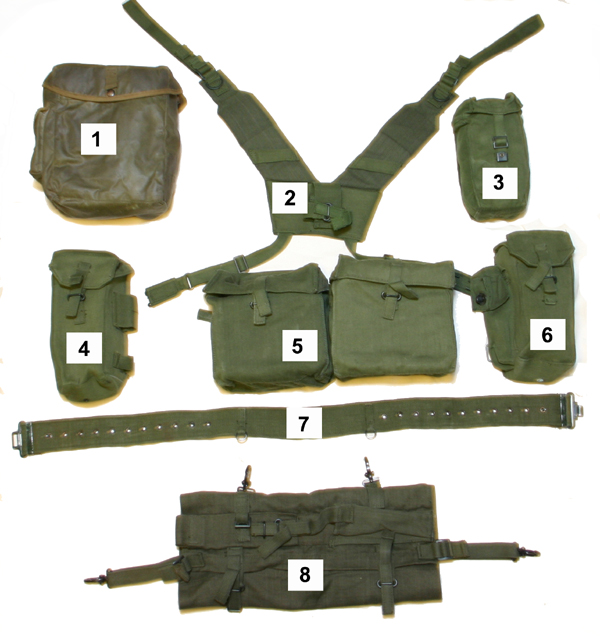
1: s6 Respirator Haversack (See
NBC). 2: Yoke. 3: Water bottle
Carrier. 4: Ammo Pouch, Left. 5: Rear
(Kidney) Pouches. 6: Ammo Pouch, Right. 7:
Belt. 8: Cape (Poncho) Carrier
NSNs
| Item |
NSN |
| Holster
Pistol |
1095-99-1204509 |
| Carrier
Cape |
8465-99-1207156 |
| Ammunition
Pouch Left |
8465-99-9736990 |
| Ammunition
Pouch Right |
8465-99-9736991 |
| Yoke
Field Pack |
8465-99-1207160 |
| Pouch
Rear |
8465-99-1207160 |
| Carrier
Water
Canteen |
8465-99-9736010 |
| Waist
Belt
Normal |
8465-99-1207155 |
| Waist
Belt Large |
8465-99-9736218 |
| Strap
Utility |
8465-99-1207159 |
| Field
Pack |
8465-99-1207157 |
| Binocular
Case |
1240-99-9736959 |
| Case
Compass |
8465-99-9736960 |
|
PLCE
Personal Load-Carrying
Equipment or PLCE for short was developed as a replacement for
the '58 pattern webbing. First introduced as a trails variant in
the mid 1980's it was not until 1990 that it was issued in large
quantities, although it was not until the late 1990's that it
finally replaced the '58 pattern.
If the '58 pattern was the
last war time derived webbing then the PLCE was the first of the
the modern webbing to be developed and it later became known as
'90 pattern WE. Originally issued in Olive, it was short lived
and in 1992 it was made out of IRR DPM material.
The PLCE was designed that
the soldier could only carry the essentials and consisted of a
belt, 2 types of yokes, 2 twin ammunition pouches, utility
pouch, water bottle pouch, entrenching tool and carrier, utility
straps, two day sacks and a Bergan.